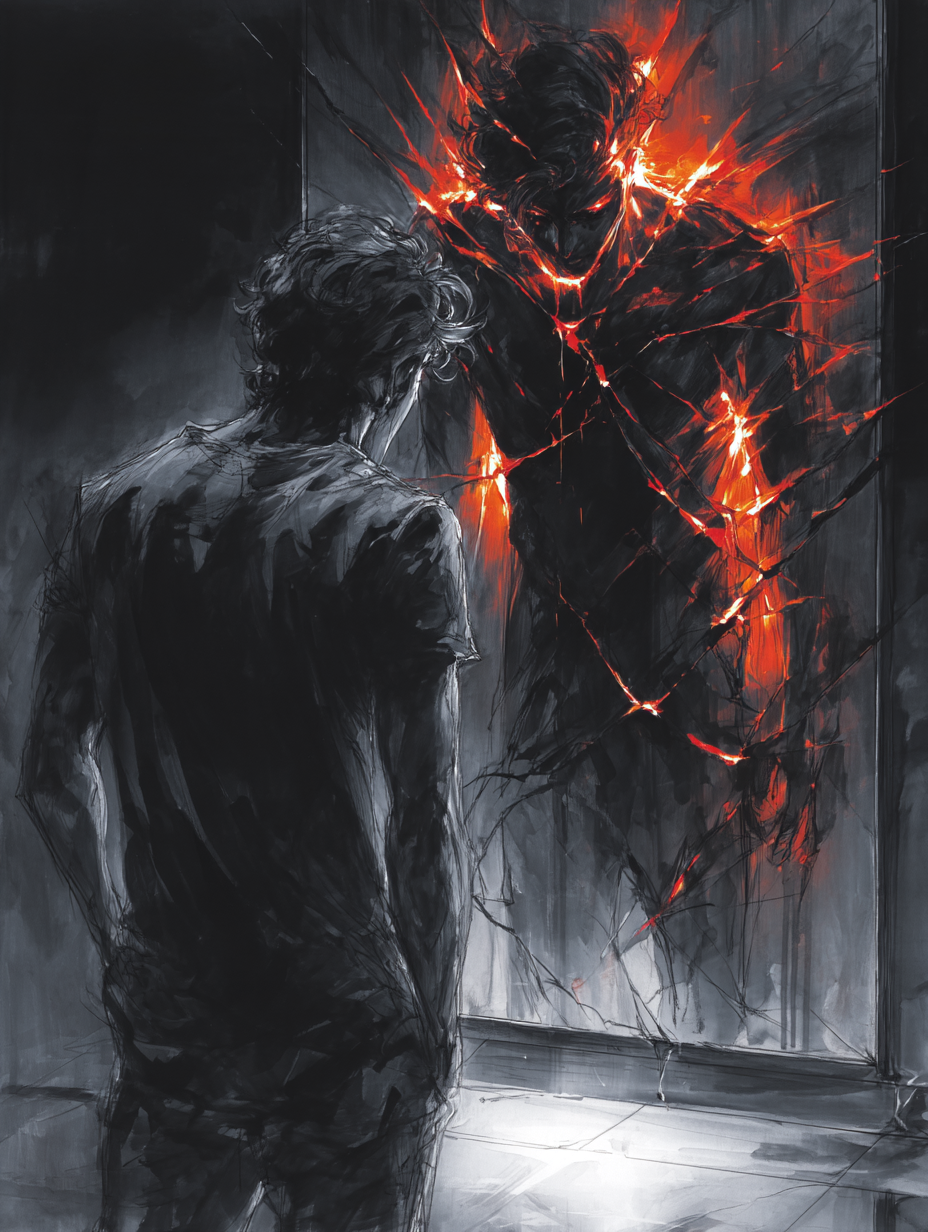
Geometry of Suffering
(…)
His entire life was a layer of filth and broken promises. The voice was right. This flesh was not a temple; it was a ruin that deserved to be demolished.
—Today —the voice resonated, not as a hiss, but as a decree carved in stone—, you shall reclaim your true face, the one that lies beneath the imposed mask.
He lifted his gaze to the mirror, beyond the grime of his life, beyond the reflection of the worn-out man. And for an instant, the fluorescent light flickered.
His reflection changed.
The skin of his face seemed to turn translucent, sickly, like wax about to melt. He saw, not a monster, but the void that lay beneath: the architecture of pale bone, the pulsating darkness of the sockets, the lie of that flaccid flesh covering him like a poorly made, dirty suit. The reflection showed him that his current form was an absence. An abominable, empty shell.
The Voice was a vibration emanating from that void, a hum demanding that the shell be broken. It was the gospel of his own nothingness.
With a surgical precision he never knew he possessed, and a strange veneration that turned the act into a profane sacrament, he brought the edge to his skin. The first contact was a freezing shock, followed by a burning sensation that stole his breath. But the voice calmed him, guided him.
—This is only the shell, the skin others planted over your original features. Remove it. It is an act of purification.
And he obeyed.
He began with the face, the most visible offering, the canvas where the world had painted its caricature of failure. Slowly, with a ritual parsimony, he began removing, layer by layer, the tissue his parents, with their expectations and fears, had placed over inherited defects and stifled virtues. Each cut was precise, almost artistic, peeling away strips of skin that fell into the sink with a wet, soft sound, revealing not red, living blood, but a darker substance, almost blackish, as if the flesh itself had rotted from years of conformity and hopelessness.
The pain was a constant, a symphony of agony that, strangely, focused him, cleansed him. With every fragment of skin that peeled away, he felt a weight lessen, a layer of the world’s lies dissolving. The flaws of others, the opinions of the world that saw him as a mediocre cog, the expectations of his family that considered him a shadow of what he should be—it all went away with those tatters of flesh.
The voice encouraged him:
—Deeper. You must rip out the construct society imposed upon you, the image they forced you to worship in the mirror.
His hands, now steady, obeyed with absolute dedication. The face emerging beneath the razor was not one of conventional beauty, nor even one recognizably human at first; it was a raw, pulsating surface, liberated from expression lines forged by worry and disappointment. It was the beginning of his true form, free from imposed responsibility, free from the gaze of others.
He paused for an instant, breath ragged, not from effort, but from a strange mixture of horror and dark jubilation. The figure in the mirror was an abomination, a grotesque work of art, and yet, for the first time in his miserable existence, he felt a glimmer of something that might be authenticity, a connection with that he the voice told him he really was.
The reflection in the mirror was a nightmare of raw meat and exposed bone, a topography of pain where before there had only existed the flaccidity of disillusionment and the pallor of resignation. But the voice, now a dark balm amidst the agony, whispered with an almost maternal tenderness:
—Magnificent. You have torn away the superficial lie. But the prison is deeper, woven into every fiber of this flesh that was never yours. Continue. Liberate yourself completely.
And he continued. The razor, now an extension of his profane will, descended down his neck, opening furrows where the skin, taut from years of stress and repressed frustration, yielded with obscene ease. There was no haste, only a methodical and reverent deconstruction.
He felt the cold of the steel sliding over tendons, the slight crunch of cartilage, and with each cut, a wave of pain so intense it transmuted into a form of perverse pleasure, a feverish lucidity where the boundaries between suffering and ecstasy became blurred, indistinguishable.
The metallic smell of his own blood, dark and thick, mixed with the aroma of candles and the stench of his stale fear, now transformed into a kind of sacrificial incense.
—The shoulders that carried the weight of others' expectations —hissed the voice—, the arms that moved without a will of their own, the hands that signed your daily surrender... they do not belong to you.
(…)